Apparently, people are complaining that our rates are too low. No, really—we have been grilled recently as to why our aircraft rental and instruction rates are so low. Maybe it’s because everyone else is charging a low “with fuel” rental price and then adding a ridiculous, higher-than-the-actual-cost-of-fuel “fuel surcharge.” It’s like people are suspicious we’re not real because everyone else is scammy. But ask our customers and come see our airplanes—we most certainly are real.
Some skeptical parties ask how we’re doing it, so in this tell-all blog post, I’m going to reveal the salacious reasons our aircraft rental rates stay so low and the dirty details behind how we do it.
Yes, We’re Real
Unfortunately, it’s not actually all that scandalous. But we do understand why; unfortunately, many flight schools go to great lengths to hook customers for tens and sometimes hundreds of thousands of dollars in fees and then fail to deliver, shut down, or simply disappear. It’s actually so common that most people in the industry just shrug when they hear about the latest fake school.
So, in the interest of transparency and helping you with your own due diligence as you research your flight training options, I’m going to explain how we do it.
Much of our lower price point has to do with using lower-cost aircraft and prioritizing safer approaches to maintenance and scheduling. Turns out it can often cost less to be safer. We trust our employees to work without micromanagement, we trust our customers to take some responsibility for their own training, and we prove it by putting pilots over profit and staying true to our founding goal of making aviation training more affordable for everyone.
A Commitment to Low Overhead
The easiest way to make flight training expensive is to build an expensive organization around it.
We don’t pay people to sit behind a front desk waiting for someone to walk in. We don’t maintain a giant administrative staff whose salaries have to be recovered through aircraft rental or instruction. Nor do we have a call center to sell you on a training package.
Our sales and marketing is done by employees whose primary duty is something else. Shellby primarily answers the phone, responds to emails and texts people back. She owns the place and takes the responsibility seriously. Not only the responsibility to ensure you the customer are happy, but that every employee has enough work to buy groceries.
We automate what can reasonably (and safely) be automated, and we put the money we would otherwise spend on unnecessary overhead into things that actually matter: aircraft, maintenance, safety equipment, and our employees.
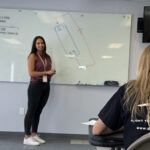
Until this year, out office was a desk at the back of a hangar. We decided a classroom would be helpful, so we upgraded to a larger hangar with a classroom, a small lobby and an office. Still, it remains largely unstaffed throughout the day.
Setting Expectations
Keeping prices low also means being honest about what a flight school should and should not be doing for you.
Upload your own damn documents.
If you have a driver’s license, medical certificate, pilot certificate, passport, logbook, or other document that needs to be uploaded into our systems, you are perfectly capable of taking a picture of it and uploading it yourself. You don’t need to pay more so that we can pay someone to do something you can do in a few minutes. Plus, paperwork is a part of this career and this hobby.
The same philosophy applies to training. We expect our students to develop a “Pilot in Command” (PIC) attitude from the start. You won’t last long as a pilot without one. That means showing up prepared, knowing what you are supposed to know, keeping track of your own requirements, and taking responsibility for your progress instead of treating your CFI like a personal concierge.
That’s not to say they won’t guide you in the beginning—they will give you as much guidance as you need. But instead of paying someone to constantly follow up and bother you about coming back to training, we assume that if you don’t come back, it’s not for you.
We also encourage students to complete their ground training and written exams early. There is no good reason to spend expensive aircraft-and-instructor time sitting on the ground learning material that can be learned independently for much less money.
Your CFI’s job is to teach you how to fly airplanes, not to watch you click through an online course. This attitude results in a lower cost for you, the student, and more productive time with the instructor.
Light Sport Aircraft: Newer Doesn’t Have to Mean More Expensive
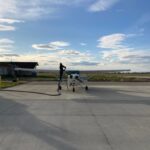
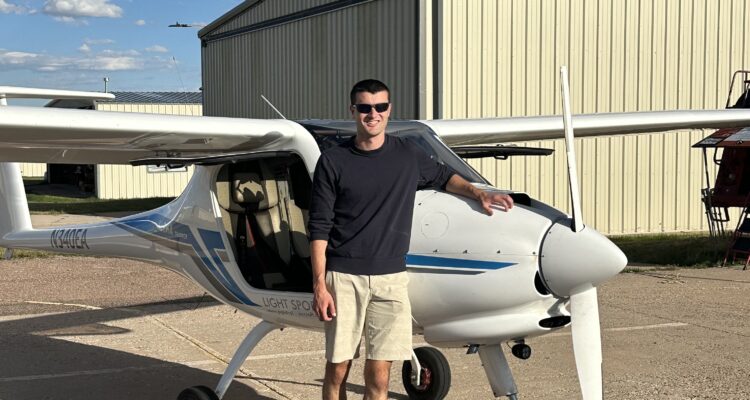
Our fleet includes modern Light Sport Aircraft because they allow us to provide a modern training environment without carrying the operating costs of a four-seat, 180-horsepower airplane when we don’t actually need four seats and 180 horsepower.
The Rotax engines in the Pipistrel Alpha Trainer and Aeroprakt A22 and A32 use significantly less fuel than the engines found in many traditional training aircraft, and the aircraft themselves are substantially lighter. That combination means you can get very good performance at a much lower from a much smaller engine.
A lighter airplane also means less mass to accelerate, less fuel required to carry that mass, and overall lower fuel costs.
Our Cessna 150, which barely has sufficient power—100 horsepower—to fly at this altitude and is traditionally just about the lowest-fuel-burn certified trainer aircraft you can find, burns about six and a half to seven gallons of fuel per hour. It’s the most expensive aircraft to operate in our fleet.
The Rotax 912UL in the Pipistrel Alpha Trainer burns 3.6 gallons per hour. That’s approximately half of the Cessna 150 and a third of most Cessna 172s upgraded to a 180 horsepower. (Cessna 172s don’t perform particularly well at our elevation unless equipped with this upgrade).
We chose the Light Sport Aircraft to give you the airplane you actually need than charge you for an airplane you don’t.
Anticipating (Rather Than Reacting to) Maintenance
Maintenance is another area where trying to save money can eventually become much more expensive.
Our maintenance philosophy: fix things before they become expensive problems.
It’s not a novel concept. Airlines and large fleet operators use scheduled preventative maintenance to maintain safer and more reliable fleets.
We not only keep common parts on hand and maintaining aircraft according to the manufacturer’s requirements but we addressing problems when they are identified rather than continuously deferring them until they become true airworthiness issues. This also means accepting that airplanes are going to need maintenance and planning for it instead of pretending they won’t.
Our flight school loses money when an airplane sits on the ground. Our students lose money and time when their lesson gets cancelled. Our shop loses money when they have to stop what they’re doing and chase down a part that should have been sitting on the shelf. Stocking parts and doing maintenance proactively costs money, but not nearly as much as waiting for something to break. We’d rather spend a little money before the airplane breaks than a lot of money after it does.
More importantly, we’d rather have an airplane that is being maintained because we chose to maintain it than one that is being maintained because we didn’t and something finally broke.
Employees First
Our employees are full-time W-2 employees, not 1099 contractors that we can shift risk onto while pretending they aren’t employees. Our mechanics get what they need to do their jobs properly. Our CFIs are paid for the time they actually work, not just the time an airplane happens to be on and moving.
Training briefings take time. Preflight preparation takes time. Postflight paperwork takes time. Student communication takes time. Reviewing regulations and preparing lessons takes time. If we expect our employees to do those things, we pay them to do them.
We also trust our employees. Micromanagement is expensive. Constantly checking whether somebody is doing the job you hired them to do requires managers, systems, paperwork, and eventually more managers to manage the systems and paperwork. Sounds like higher rental fees to me.
We’d rather hire competent people, give them the tools they need, and let them do their jobs. This is part of why our interview process involves four interviews and a flight test. It’s why we work so hard to ensure everyone is a good cultural fit in our shop and why employees who can’t handle the responsibility don’t work here for long.
Unhappy employees cost money. People who hate their jobs don’t generally go out of their way to make a business better. People who are treated well tend to care about the work they do. If you want employees to care about your customers, you probably ought to give them a reason to care about the company first.
Bulk Fuel Ordering
Fuel is another area where scale matters. We use 91UL non-ethanol fuel in our aircraft because it is an appropriate fuel for those engines and avoids some of the problems associated with the leaded aviation fuel you’ll buy from the pump. Technically, we mix use during the summer, but whenever possible we use the less-expensive, less-poisonous-to-our-employees-and-customers 91UL mogas.
Rather than buying fuel a little at a time at retail prices, we purchase it in bulk and store it in our own fuel trucks. That means we can control our fuel supply, reduce unnecessary markup, and avoid paying somebody else to perform a service we can reasonably perform ourselves.
Every dollar we don’t have to spend on fuel is another dollar we don’t have to recover from a student.
Pilots Above Profit
I was a student pilot once. I remember what it was like to walk into a flight school knowing almost nothing about the industry and blindly trusting that the people sitting across the desk knew what they were talking about (turned out they didn’t, really). I also remember encountering businesses that seemed much more interested in extracting money from me than helping me become a pilot.
Flight schools have developed a reputation for being scammy businesses for a reason. There have been plenty of schools that charged enormous amounts of money, made enormous promises, and delivered very little. Ponzi schemes are also common in this industry; every few months now we hear about flight school owners taking large deposits and disappearing.
We are a business, obviously. We have bills to pay, airplanes to maintain, employees to compensate, and investors who would presumably prefer that we remain solvent and operational. But the objective is not to maximize the amount of money we can extract from every student, it’s to produce better pilots.
Okay, But Why Are Any of Us Here?
Businesses are ultimately about benefits, not money. Money is a tool that allows the business to continue providing benefits. If you lose sight of the benefit you’re providing yourself and your customers, you become very good at making money while becoming increasingly bad at whatever it was that made people want to give you money in the first place.
Employee and Customer Investment
Our aircraft are managed aircraft. This means the flight school itself doesn’t own its aircraft, it manages them for private owners and investors.
The large majority of our aircraft are owned by students actively pursuing their own ratings. This saves them a lot of money, but it also saves you money because their primary return on investment is the even-bigger cost savings on their own training. It shifts the priority from making money on customers to helping everyone save money.
Cost Saving Innovation
Innovation is an overused word. But saving you money and providing reliable, safe flight training is a dynamic process. We’re actively investing in and experimenting with new techniques.
Several of the instructors on staff have come together to purchase one of our aircraft, creating a structure where the people actually flying and teaching in the airplane have a direct stake in its success. We’re hoping to propagate this model over time to make it a foundation of what we do here: employee-owned assets helps invest everyone in the success of the business.
Success in Diversity
We also want to see people who have historically had fewer opportunities in aviation succeed in the industry. Making flight training less expensive doesn’t magically solve every barrier to becoming a professional pilot, but it does remove one of the biggest ones.
We believe a broader range of people in aviation—both in our business and in the industry in general—is good for all of us. Different backgrounds, experiences, and perspectives bring different ways of looking at problems, and aviation is an industry where identifying problems before they become accidents is pretty f@%$ing important.
“Um, We’re Just Not Like Other Flight Schools”
We aren’t selling you a $150,000 program and hoping you don’t notice that you aren’t getting what you paid for.
We’re keeping our overhead low, using aircraft that make economic sense, maintaining them proactively, buying fuel intelligently, paying our employees properly, asking our customers to take responsibility for the parts of training they can control, and trying to build a flight school where the people involved actually want the airplanes to fly and the students to succeed. It’s not rocket science. Though, I guess it is the foundational principles of aerodynamics we teach that inform rocket science, so…